Testing and status
Every claim about this project should be checkable. This page says what is tested, how to run it, and what is not proven yet.
How the checks are run
tools/verify.sh            # everything; about two minutes with the board builds
tools/verify.sh --quick    # skip the Arduino builds
In the project's (private) code repository, each run writes a dated log with the machine, every command and everything it printed, so a run can be shown later exactly as it happened. Latest full run: 17 November 2026, all passed.
What the automated checks cover
| Suite | Checks | What it proves |
|---|---|---|
| Whole system over simulated controllers | 11 | An authorised driver is admitted and parked; a borrowed card is refused; unknown cards are masked in the record; manual openings record their reason; the console needs a login and CSRF token; commands fail cleanly when a cable is pulled. |
| Units: record, plates, rules, protocol | 16 | Any edit or deletion in the record is found; plates match exactly, never as a substring; the 19 decision cases give the intended answers; damaged frames are rejected. |
| Vision | 8 | Each enrolled face matches only itself; distant faces are ignored; synthetic plates are read end to end. |
| Firmware on a serial device | 8 | The real gate and bay sketches, compiled for the laptop and run behind a pseudo-terminal, talk to the real site software: handshake, acknowledged commands, one report per card, bay colours on the right pins, and the barrier closing itself 3 seconds after the computer goes silent. |
| Demo engine (browser) | 38 | The browser's rules give the same answer as the site software on all 19 shared cases; its SHA-256 and tamper detection are correct. |
| Firmware logic (C++) | 78 | The protocol codec against the shared vector file; barrier timing, reversal mid-sweep, hold-time limits, the silence watchdog, the millis() wrap at 49 days; bay debounce, colours, reservation blink and expiry. |
| Board builds | 5 | Gate and bay sketches for the Uno R4 WiFi and the Uno R3; camera sketch for the ESP32-CAM. |
Measured on the development laptop (Apple M1): finding and matching a face in one 640×480 frame takes a median of 14 ms over 20 frames.
On the bench
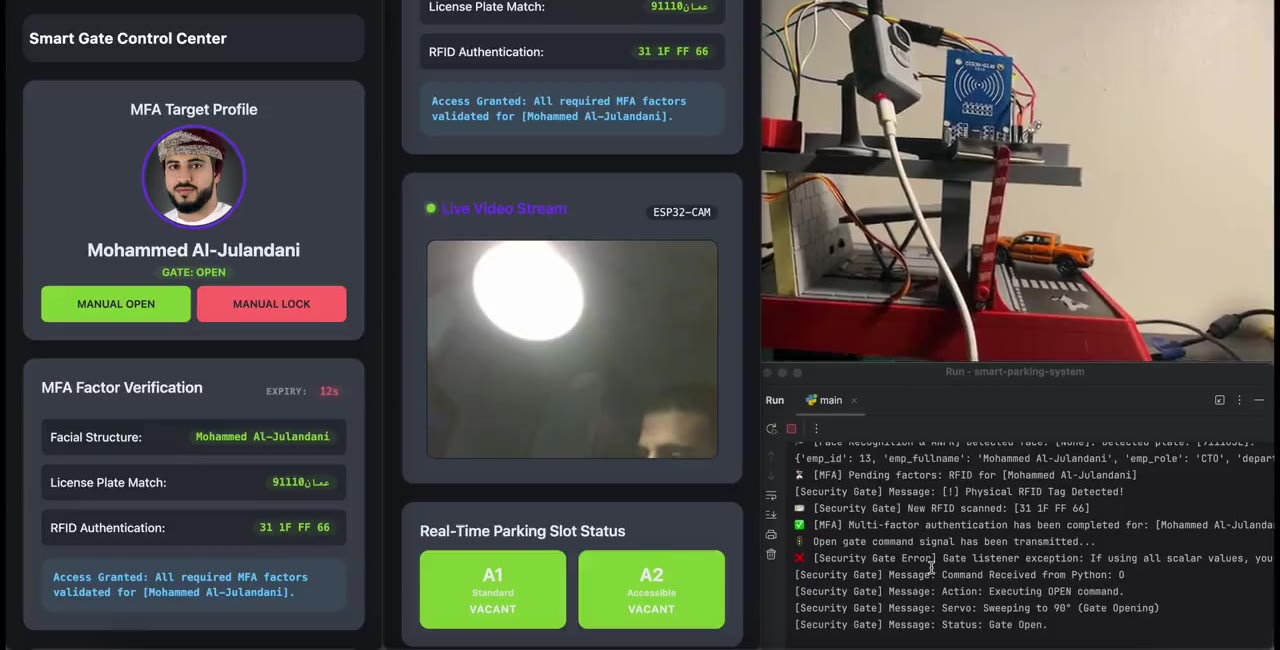
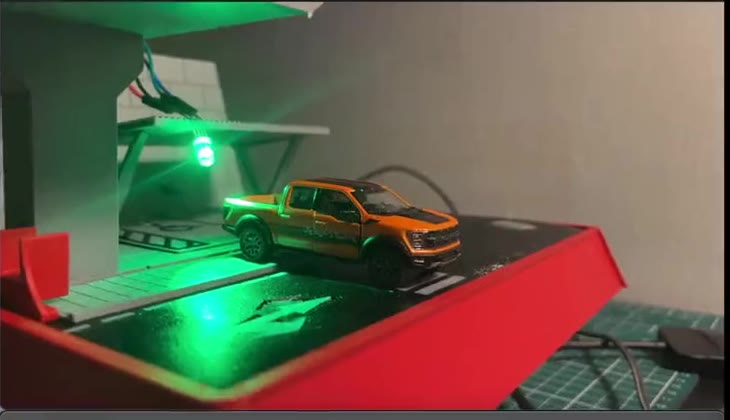
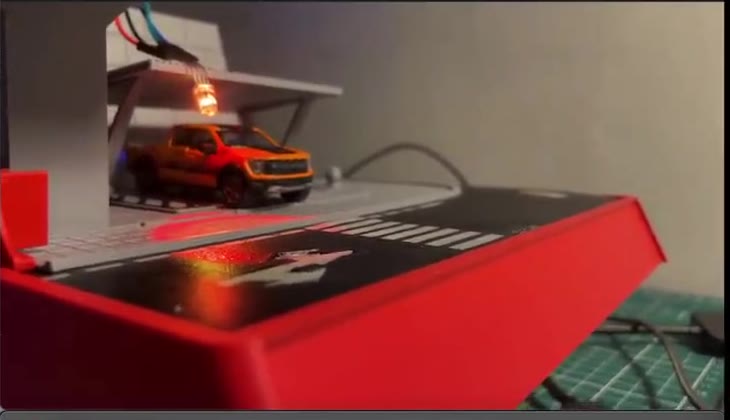
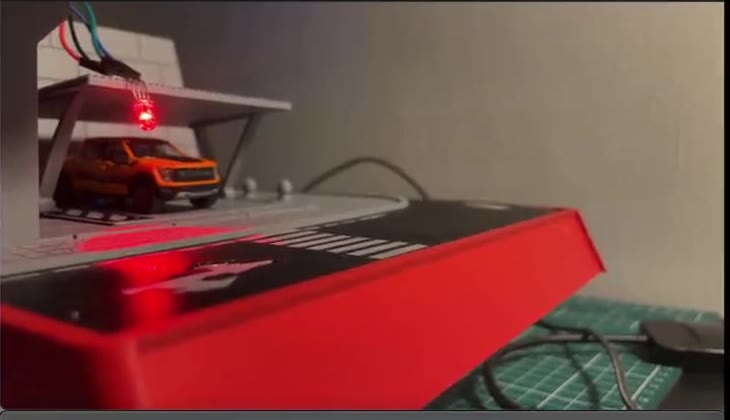
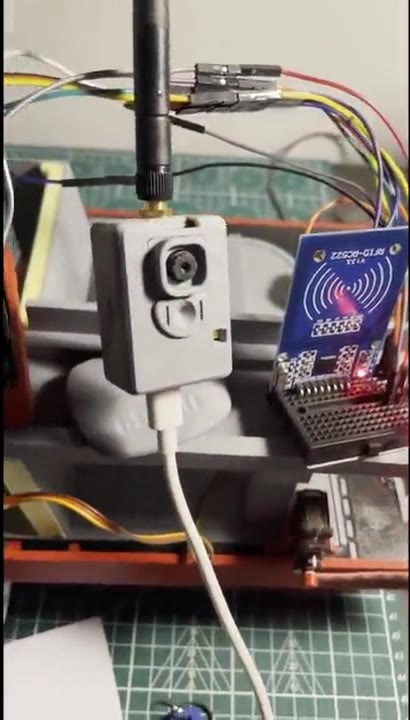
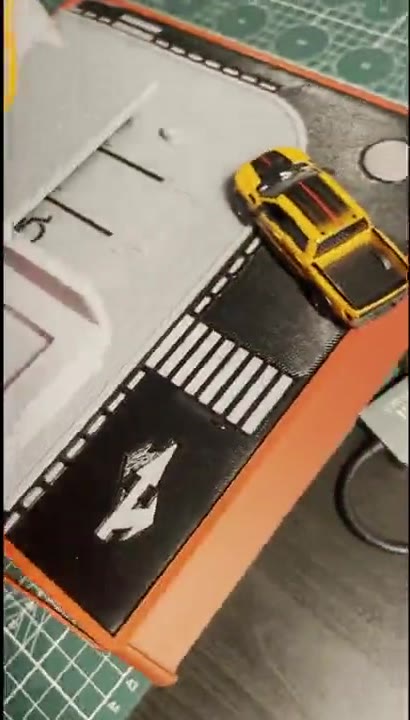
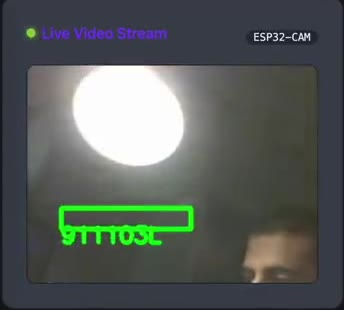
Stills from the recorded bench test of the first build on the scale model.
The self-audit
Before rebuilding, I read every line of the first build and wrote down what was wrong. 30 defects:
| Area | Count | Examples |
|---|---|---|
| Security | 8 | A cloud API key and Wi-Fi password in the code; SQL built from card numbers; gate endpoints with no login; plate 123 accepted for car 91234 |
| Correctness | 9 | A reconnect check that was always true; the CSV log raised an error on every call and was never written (visible in the bench still above) |
| Reliability | 9 | Auto-close lived in the camera loop, so a stalled camera left the gate open; the camera never rejoined Wi-Fi; no sensor debounce |
| Missing | 4 | No capacity check, no bay guidance from the gate, no way to run without hardware, no tests |
The rebuild addresses each one in the site software or firmware 2.0.0. The fixes that live in firmware are proven on the laptop and wait for the bench run.
History
First build wins Diploma Best Project Idea, UTAS Muscat Poster Day.
Bench test of the first build recorded on the scale model.
Self-audit (30 defects). Site software rebuilt with a simulator and tests; firmware 2.0.0 for both controllers; camera sketch fixed.
Flash firmware 2.0.0 on the model and repeat the bench tests, including pulling the computer's cable with the barrier up.
Not proven yet
- Plate and face reading outdoors, at night and in fog. The tests use synthetic plates and three enrolled photos; no accuracy figure is claimed.
- Firmware 2.0.0 on the real boards, servo and sensors.
- Time at the barrier with real drivers, and fuel or time saved.
- Weatherproof parts, a mains barrier, and the cost per bay.